High Velocity Events
High Velocity Events are Amazon’s biggest shopping moments, including Prime Day, Prime Big Deal Days, and Black Friday/Cyber Monday.
Project:
High Velocity Events
Time:
3 years
Role:
UX Designer role

In 2023, I joined the team behind Amazon’s biggest shopping events and spent the next three years designing experiences across High Velocity Events, with Prime Day at the center of much of my work.
These events moved quickly and brought together large cross-functional teams across design, product, engineering, marketing, and partner groups. Timelines were tight, priorities shifted often, and a big part of my role was bringing many moving pieces together into a clear and cohesive customer experience.
Over time, I took on more ownership and became the lead designer for High Velocity Events, helping shape the overall experience, guide key design decisions, and bring the work together for senior leadership reviews.
Working on these events year after year gave me a unique perspective on how deal shopping was evolving, what we were learning from each launch, and where there was still room to make the experience simpler, more relevant, and more useful for customers.
How Prime Day Evolved Over the Years
2023: Helping customers find what mattered
In 2023, I helped design the Prime Day experience with a focus on making discovery feel more useful and personal. With such a large number of deals available at once, the experience could easily become a long list of products customers had to work through themselves.
We began moving beyond that model by introducing more personalized recommendations, Buzzworthy Deals, creator-led content, shopping video, personalized offers, and new ways to surface products customers might actually care about. The goal was to give people more meaningful starting points rather than expecting everyone to shop the event in the same way.
Prime Day 2023 generated more than $13B in sales, finishing about 13% above goal and 33% higher than the year before.

2024: Making a huge event easier to explore
By 2024, Prime Day had become richer and more personalized, but that also meant customers had more to take in. I took on more ownership of the experience and focused on making a growing amount of content easier to understand and navigate.
We improved filters and navigation, introduced new five-product cards, created Top 100 Deals and regularly refreshed deal drops, expanded interest-based shopping, and introduced more inspirational creator content. We also built a stronger visual system across the event so that all of these different experiences still felt like they belonged together.
The biggest CX shift was moving from simply adding more content to organizing it more intentionally. Customers had clearer ways to narrow the experience, find a useful place to start, and discover something relevant without scrolling through everything.
Prime Day 2024 reached approximately $14.2B in sales, growing 7.8% year over year.

2025: Leading Prime Day around the customer
By 2025, I was leading the UX for Prime Day. My role shifted from designing individual parts of the experience to thinking about how the event should feel as a whole. With the event launching across 26 countries and many teams contributing at once, I spent a lot of time creating clarity, making experience-level decisions, and keeping the work centered on what would make Prime Day easier and more useful for customers.
We pushed the experience toward something more dynamic and responsive, introducing personalized collections, Today’s Big Deals, fresh deal discovery, stronger brand moments, and new ways to surface relevant products throughout the event. The goal was for Prime Day to feel less like one enormous sale customers had to navigate and more like an experience that actively helped them find what was worth exploring.
Prime Day 2025 generated $20.2B in sales, up 13.3% year over year, making it the biggest Prime Day yet.

After three years of working on Prime Day, I wanted to step back and look at the experience from a wider perspective.
We had added more ways to personalize, discover, and shop deals, but customers were still entering an enormous assortment and doing much of the work themselves: deciding what mattered, figuring out where to start, and narrowing everything down.
I took those learnings into a three-week future vision sprint to explore how the Event Page could become more guided, personal, and inspiring.
Reimagining the Event Page

Understanding the customer
I started by reviewing the current Event Page to understand what was working well and where customers were still getting stuck.
The page offered a huge number of deals, but that also made it harder to know where to start. Customers often had to scan through a lot of content, decide what was worth their attention, and use filters to narrow things down.
Some parts of the experience worked much better than others, especially when the value of a deal or the urgency around it was immediately clear. Those moments made it easier for customers to decide what to explore.
That helped clarify the opportunity. Instead of showing customers more, the page needed to help them find what mattered faster by creating clearer hierarchy, surfacing the most useful deals, and reducing the effort it took to browse.
Competitive Analysis
I looked at how other shopping experiences approached three parts of the journey: product-heavy grids, filters and navigation, and large promotional event pages.
I studied examples from ASOS, Pinterest, Walmart, Target, TikTok, Best Buy, and others to see how different experiences organize a lot of content while still making browsing feel simple and engaging.
I paid particular attention to how they guided attention, surfaced important content, and helped customers move through dense pages without feeling overwhelmed.

How might we help customers quickly understand what’s worth exploring and make a huge selection of deals feel more relevant to them?
Design Principles
I distilled the research and opportunity areas into four design principles to guide how the Event Page could become easier to navigate, more relevant, and more engaging to explore.
Lead with what matters
Make the strongest, most relevant, and time-sensitive deals easier to recognize so customers know where to start.
Make narrowing feel effortless
Bring filters and shortcuts closer to the shopping experience so customers can refine what they see without breaking their flow.
Create moments of discovery
Use richer collections, brands, and visual storytelling to break up dense product grids and give customers more reasons to keep exploring.
Use personalization to guide
Go beyond simply recommending products and use customer context to help people understand what might be useful or worth exploring next.
The Solution
I translated these principles into a set of future Event Page concepts that rethink how customers move through the experience.
The concepts explored four connected areas: bringing the strongest deals forward, making filters and browsing easier, introducing more inspiring discovery moments, and using personalization to give customers more useful guidance.
Concept 1: Making the Best Deals Easier to Find
Customer Problem: Customers rely heavily on price and value signals, but the top of the page does not make it easy to understand which deals matter most. Time-sensitive deals perform well, showing that urgency can help people decide faster.
Design Direction: Make the top of the page more focused and useful by bringing the strongest, most relevant, and most time-sensitive deals forward.

Concept 2: Bringing Inspiration to the Deals Grid
Customer Problem: Large deal grids are efficient, but they can feel repetitive and overwhelming when customers are browsing without a specific product in mind.
Design Direction: Break up long product grids with richer, more curated moments that give customers a reason to explore.

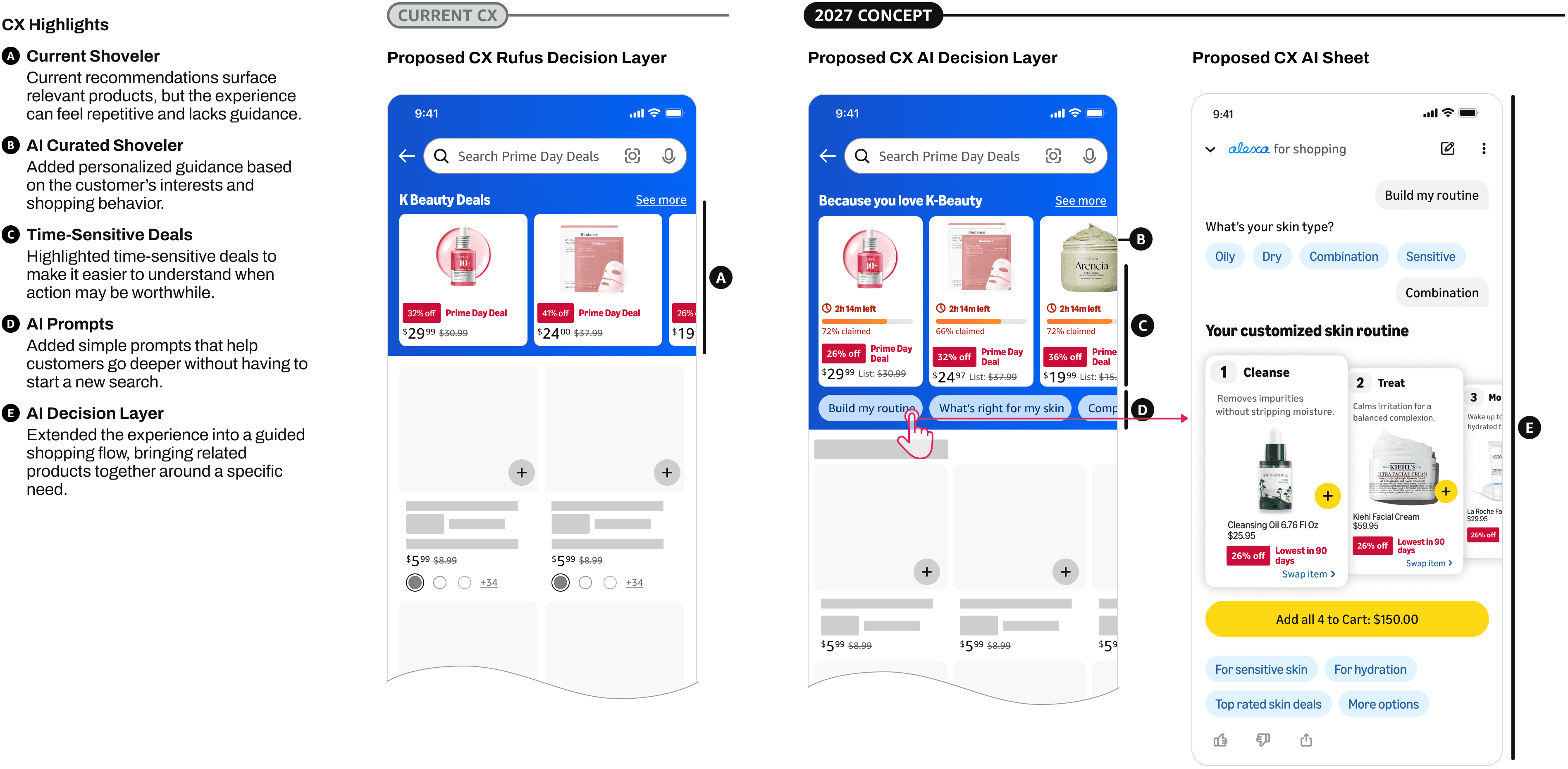
Concept 3: Turning Recommendations Into Guided Shopping using AI
Customer Problem: Personalized product recommendations can surface relevant items, but they do not always help customers understand what to do next or how those products fit together.
Design Direction: Use AI-powered guidance to turn passive recommendations into something more useful and actionable.
Concept 4: Making a Huge Deal Selection Easier to Navigate
Customer Problem: Customers can narrow deals today, but the filtering experience takes effort and assumes they already know exactly what they want. Dense product grids also make it harder to scan and compare options.
Design Direction: Bring useful filters directly into the browsing experience and let the product grid respond immediately to what the customer selects.

Extending the Vision Across Other Major Shopping Events
The ideas were designed as a system rather than a one-off Prime Day redesign. I explored how the same structure could adapt to Black Friday and Cyber Monday while keeping the interaction patterns familiar and changing the merchandising, color, and event storytelling.

Building a More Flexible Event Experience
To make the vision scalable across large shopping events, I created a set of reusable experience patterns that could work together across the page.

Reflection
Working on High Velocity Events taught me how to design through speed, scale, and technical constraints without losing sight of the customer. A big part of the work was making thoughtful tradeoffs, finding ideas that could work within existing systems, and still pushing the experience forward.
The future vision project was especially meaningful because it gave me space to think beyond immediate constraints and explore where the experience could go next. The work was well received by the team and earned strong feedback from leadership, and several of the ideas were seen as realistic directions that could influence upcoming event experiences over the next year or so. It was a good reminder that future vision work can be both ambitious and grounded enough to shape what actually gets built.

©2026 | Sarah Zaheer
R
TIME:
PST
High Velocity Events
High Velocity Events are Amazon’s biggest shopping moments, including Prime Day, Prime Big Deal Days, and Black Friday/Cyber Monday.
Project:
High Velocity Events
Time:
3 years
Role:
UX Designer role
In 2023, I joined the team behind Amazon’s biggest shopping events and spent the next three years designing experiences across High Velocity Events, with Prime Day at the center of much of my work.
These events moved quickly and brought together large cross-functional teams across design, product, engineering, marketing, and partner groups. Timelines were tight, priorities shifted often, and a big part of my role was bringing many moving pieces together into a clear and cohesive customer experience.
Over time, I took on more ownership and became the lead designer for High Velocity Events, helping shape the overall experience, guide key design decisions, and bring the work together for senior leadership reviews.
Working on these events year after year gave me a unique perspective on how deal shopping was evolving, what we were learning from each launch, and where there was still room to make the experience simpler, more relevant, and more useful for customers.
How Prime Day Evolved Over the Years
2023: Helping customers find what mattered
In 2023, I helped design the Prime Day experience with a focus on making discovery feel more useful and personal. With such a large number of deals available at once, the experience could easily become a long list of products customers had to work through themselves.
We began moving beyond that model by introducing more personalized recommendations, Buzzworthy Deals, creator-led content, shopping video, personalized offers, and new ways to surface products customers might actually care about. The goal was to give people more meaningful starting points rather than expecting everyone to shop the event in the same way.
Prime Day 2023 generated more than $13B in sales, finishing about 13% above goal and 33% higher than the year before.
2024: Making a huge event easier to explore
By 2024, Prime Day had become richer and more personalized, but that also meant customers had more to take in. I took on more ownership of the experience and focused on making a growing amount of content easier to understand and navigate.
We improved filters and navigation, introduced new five-product cards, created Top 100 Deals and regularly refreshed deal drops, expanded interest-based shopping, and introduced more inspirational creator content. We also built a stronger visual system across the event so that all of these different experiences still felt like they belonged together.
The biggest CX shift was moving from simply adding more content to organizing it more intentionally. Customers had clearer ways to narrow the experience, find a useful place to start, and discover something relevant without scrolling through everything.
Prime Day 2024 reached approximately $14.2B in sales, growing 7.8% year over year.
2025: Leading Prime Day around the customer
By 2025, I was leading the UX for Prime Day. My role shifted from designing individual parts of the experience to thinking about how the event should feel as a whole. With the event launching across 26 countries and many teams contributing at once, I spent a lot of time creating clarity, making experience-level decisions, and keeping the work centered on what would make Prime Day easier and more useful for customers.
We pushed the experience toward something more dynamic and responsive, introducing personalized collections, Today’s Big Deals, fresh deal discovery, stronger brand moments, and new ways to surface relevant products throughout the event. The goal was for Prime Day to feel less like one enormous sale customers had to navigate and more like an experience that actively helped them find what was worth exploring.
Prime Day 2025 generated $20.2B in sales, up 13.3% year over year, making it the biggest Prime Day yet.
After three years of working on Prime Day, I wanted to step back and look at the experience from a wider perspective.
We had added more ways to personalize, discover, and shop deals, but customers were still entering an enormous assortment and doing much of the work themselves: deciding what mattered, figuring out where to start, and narrowing everything down.
I took those learnings into a three-week future vision sprint to explore how the Event Page could become more guided, personal, and inspiring.
Reimagining the Event Page
Understanding the customer
I started by reviewing the current Event Page to understand what was working well and where customers were still getting stuck.
The page offered a huge number of deals, but that also made it harder to know where to start. Customers often had to scan through a lot of content, decide what was worth their attention, and use filters to narrow things down.
Some parts of the experience worked much better than others, especially when the value of a deal or the urgency around it was immediately clear. Those moments made it easier for customers to decide what to explore.
That helped clarify the opportunity. Instead of showing customers more, the page needed to help them find what mattered faster by creating clearer hierarchy, surfacing the most useful deals, and reducing the effort it took to browse.
Competitive Analysis
I looked at how other shopping experiences approached three parts of the journey: product-heavy grids, filters and navigation, and large promotional event pages.
I studied examples from ASOS, Pinterest, Walmart, Target, TikTok, Best Buy, and others to see how different experiences organize a lot of content while still making browsing feel simple and engaging.
I paid particular attention to how they guided attention, surfaced important content, and helped customers move through dense pages without feeling overwhelmed.
How might we help customers quickly understand what’s worth exploring and make a huge selection of deals feel more relevant to them?
Design Principles
I distilled the research and opportunity areas into four design principles to guide how the Event Page could become easier to navigate, more relevant, and more engaging to explore.
Lead with what matters
Make the strongest, most relevant, and time-sensitive deals easier to recognize so customers know where to start.
Make narrowing feel effortless
Bring filters and shortcuts closer to the shopping experience so customers can refine what they see without breaking their flow.
Create moments of discovery
Use richer collections, brands, and visual storytelling to break up dense product grids and give customers more reasons to keep exploring.
Use personalization to guide
Go beyond simply recommending products and use customer context to help people understand what might be useful or worth exploring next.
The Solution
I translated these principles into a set of future Event Page concepts that rethink how customers move through the experience.
The concepts explored four connected areas: bringing the strongest deals forward, making filters and browsing easier, introducing more inspiring discovery moments, and using personalization to give customers more useful guidance.
Concept 1: Making the Best Deals Easier to Find
Customer Problem: Customers rely heavily on price and value signals, but the top of the page does not make it easy to understand which deals matter most. Time-sensitive deals perform well, showing that urgency can help people decide faster.
Design Direction: Make the top of the page more focused and useful by bringing the strongest, most relevant, and most time-sensitive deals forward.
Concept 2: Bringing Inspiration to the Deals Grid
Customer Problem: Large deal grids are efficient, but they can feel repetitive and overwhelming when customers are browsing without a specific product in mind.
Design Direction: Break up long product grids with richer, more curated moments that give customers a reason to explore.
Concept 3: Turning Recommendations Into Guided Shopping using AI
Customer Problem: Personalized product recommendations can surface relevant items, but they do not always help customers understand what to do next or how those products fit together.
Design Direction: Use AI-powered guidance to turn passive recommendations into something more useful and actionable.
Concept 4: Making a Huge Deal Selection Easier to Navigate
Customer Problem: Customers can narrow deals today, but the filtering experience takes effort and assumes they already know exactly what they want. Dense product grids also make it harder to scan and compare options.
Design Direction: Bring useful filters directly into the browsing experience and let the product grid respond immediately to what the customer selects.
Extending the Vision Across Other Major Shopping Events
The ideas were designed as a system rather than a one-off Prime Day redesign. I explored how the same structure could adapt to Black Friday and Cyber Monday while keeping the interaction patterns familiar and changing the merchandising, color, and event storytelling.
Building a More Flexible Event Experience
To make the vision scalable across large shopping events, I created a set of reusable experience patterns that could work together across the page.
Reflection
Working on High Velocity Events taught me how to design through speed, scale, and technical constraints without losing sight of the customer. A big part of the work was making thoughtful tradeoffs, finding ideas that could work within existing systems, and still pushing the experience forward.
The future vision project was especially meaningful because it gave me space to think beyond immediate constraints and explore where the experience could go next. The work was well received by the team and earned strong feedback from leadership, and several of the ideas were seen as realistic directions that could influence upcoming event experiences over the next year or so. It was a good reminder that future vision work can be both ambitious and grounded enough to shape what actually gets built.
©2026 | Sarah Zaheer
R
TIME:
PST
High Velocity Events
High Velocity Events are Amazon’s biggest shopping moments, including Prime Day, Prime Big Deal Days, and Black Friday/Cyber Monday.
Project:
High Velocity Events
Time:
3 years
Role:
UX Designer role
In 2023, I joined the team behind Amazon’s biggest shopping events and spent the next three years designing experiences across High Velocity Events, with Prime Day at the center of much of my work.
These events moved quickly and brought together large cross-functional teams across design, product, engineering, marketing, and partner groups. Timelines were tight, priorities shifted often, and a big part of my role was bringing many moving pieces together into a clear and cohesive customer experience.
Over time, I took on more ownership and became the lead designer for High Velocity Events, helping shape the overall experience, guide key design decisions, and bring the work together for senior leadership reviews.
Working on these events year after year gave me a unique perspective on how deal shopping was evolving, what we were learning from each launch, and where there was still room to make the experience simpler, more relevant, and more useful for customers.
How Prime Day Evolved Over the Years
2023: Helping customers find what mattered
In 2023, I helped design the Prime Day experience with a focus on making discovery feel more useful and personal. With such a large number of deals available at once, the experience could easily become a long list of products customers had to work through themselves.
We began moving beyond that model by introducing more personalized recommendations, Buzzworthy Deals, creator-led content, shopping video, personalized offers, and new ways to surface products customers might actually care about. The goal was to give people more meaningful starting points rather than expecting everyone to shop the event in the same way.
Prime Day 2023 generated more than $13B in sales, finishing about 13% above goal and 33% higher than the year before.
2024: Making a huge event easier to explore
By 2024, Prime Day had become richer and more personalized, but that also meant customers had more to take in. I took on more ownership of the experience and focused on making a growing amount of content easier to understand and navigate.
We improved filters and navigation, introduced new five-product cards, created Top 100 Deals and regularly refreshed deal drops, expanded interest-based shopping, and introduced more inspirational creator content. We also built a stronger visual system across the event so that all of these different experiences still felt like they belonged together.
The biggest CX shift was moving from simply adding more content to organizing it more intentionally. Customers had clearer ways to narrow the experience, find a useful place to start, and discover something relevant without scrolling through everything.
Prime Day 2024 reached approximately $14.2B in sales, growing 7.8% year over year.
2025: Leading Prime Day around the customer
By 2025, I was leading the UX for Prime Day. My role shifted from designing individual parts of the experience to thinking about how the event should feel as a whole. With the event launching across 26 countries and many teams contributing at once, I spent a lot of time creating clarity, making experience-level decisions, and keeping the work centered on what would make Prime Day easier and more useful for customers.
We pushed the experience toward something more dynamic and responsive, introducing personalized collections, Today’s Big Deals, fresh deal discovery, stronger brand moments, and new ways to surface relevant products throughout the event. The goal was for Prime Day to feel less like one enormous sale customers had to navigate and more like an experience that actively helped them find what was worth exploring.
Prime Day 2025 generated $20.2B in sales, up 13.3% year over year, making it the biggest Prime Day yet.
After three years of working on Prime Day, I wanted to step back and look at the experience from a wider perspective.
We had added more ways to personalize, discover, and shop deals, but customers were still entering an enormous assortment and doing much of the work themselves: deciding what mattered, figuring out where to start, and narrowing everything down.
I took those learnings into a three-week future vision sprint to explore how the Event Page could become more guided, personal, and inspiring.
Reimagining the Event Page
Understanding the customer
I started by reviewing the current Event Page to understand what was working well and where customers were still getting stuck.
The page offered a huge number of deals, but that also made it harder to know where to start. Customers often had to scan through a lot of content, decide what was worth their attention, and use filters to narrow things down.
Some parts of the experience worked much better than others, especially when the value of a deal or the urgency around it was immediately clear. Those moments made it easier for customers to decide what to explore.
That helped clarify the opportunity. Instead of showing customers more, the page needed to help them find what mattered faster by creating clearer hierarchy, surfacing the most useful deals, and reducing the effort it took to browse.
Competitive Analysis
I looked at how other shopping experiences approached three parts of the journey: product-heavy grids, filters and navigation, and large promotional event pages.
I studied examples from ASOS, Pinterest, Walmart, Target, TikTok, Best Buy, and others to see how different experiences organize a lot of content while still making browsing feel simple and engaging.
I paid particular attention to how they guided attention, surfaced important content, and helped customers move through dense pages without feeling overwhelmed.
How might we help customers quickly understand what’s worth exploring and make a huge selection of deals feel more relevant to them?
Design Principles
I distilled the research and opportunity areas into four design principles to guide how the Event Page could become easier to navigate, more relevant, and more engaging to explore.
Lead with what matters
Make the strongest, most relevant, and time-sensitive deals easier to recognize so customers know where to start.
Make narrowing feel effortless
Bring filters and shortcuts closer to the shopping experience so customers can refine what they see without breaking their flow.
Create moments of discovery
Use richer collections, brands, and visual storytelling to break up dense product grids and give customers more reasons to keep exploring.
Use personalization to guide
Go beyond simply recommending products and use customer context to help people understand what might be useful or worth exploring next.
The Solution
I translated these principles into a set of future Event Page concepts that rethink how customers move through the experience.
The concepts explored four connected areas: bringing the strongest deals forward, making filters and browsing easier, introducing more inspiring discovery moments, and using personalization to give customers more useful guidance.
Concept 1: Making the Best Deals Easier to Find
Customer Problem: Customers rely heavily on price and value signals, but the top of the page does not make it easy to understand which deals matter most. Time-sensitive deals perform well, showing that urgency can help people decide faster.
Design Direction: Make the top of the page more focused and useful by bringing the strongest, most relevant, and most time-sensitive deals forward.
Concept 2: Bringing Inspiration to the Deals Grid
Customer Problem: Large deal grids are efficient, but they can feel repetitive and overwhelming when customers are browsing without a specific product in mind.
Design Direction: Break up long product grids with richer, more curated moments that give customers a reason to explore.
Concept 3: Turning Recommendations Into Guided Shopping using AI
Customer Problem: Personalized product recommendations can surface relevant items, but they do not always help customers understand what to do next or how those products fit together.
Design Direction: Use AI-powered guidance to turn passive recommendations into something more useful and actionable.
Concept 4: Making a Huge Deal Selection Easier to Navigate
Customer Problem: Customers can narrow deals today, but the filtering experience takes effort and assumes they already know exactly what they want. Dense product grids also make it harder to scan and compare options.
Design Direction: Bring useful filters directly into the browsing experience and let the product grid respond immediately to what the customer selects.
Extending the Vision Across Other Major Shopping Events
The ideas were designed as a system rather than a one-off Prime Day redesign. I explored how the same structure could adapt to Black Friday and Cyber Monday while keeping the interaction patterns familiar and changing the merchandising, color, and event storytelling.
Building a More Flexible Event Experience
To make the vision scalable across large shopping events, I created a set of reusable experience patterns that could work together across the page.
Reflection
Working on High Velocity Events taught me how to design through speed, scale, and technical constraints without losing sight of the customer. A big part of the work was making thoughtful tradeoffs, finding ideas that could work within existing systems, and still pushing the experience forward.
The future vision project was especially meaningful because it gave me space to think beyond immediate constraints and explore where the experience could go next. The work was well received by the team and earned strong feedback from leadership, and several of the ideas were seen as realistic directions that could influence upcoming event experiences over the next year or so. It was a good reminder that future vision work can be both ambitious and grounded enough to shape what actually gets built.
©2026 | Sarah Zaheer
R
TIME:
PST
Menu